 seedlookout
 Seeds
Seeds Seed map
 Seed finder
 Structures
 Tools
Tools Articles
 About
AboutSeedLookout research
Page updated
These are our own studies: seeds we checked in the game, comparisons between our seed map and finders and the game, and samples measured with our generation models. Each one says what it tested and what it does not show, and links to the full write-up with its data.
A comparison with the game covers only the cases it selected; a model sample is a prediction, not a game check. How SeedLookout is made
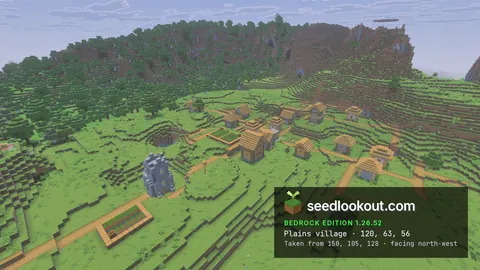
Seeds checked in the game
All 187 published seeds passed our game check: each listed structure and biome was at its coordinates in the edition and version shown.
- Method and sample
- Our finder and seed map predict where each feature is. The verifier then generates the seed in the exact game release in a fresh world, records what the game built at each listed coordinate and takes screenshots, and a person visits each location in the game before the seed is published.
- Tested
- Game: Java 26.3, Java 1.20.1, Bedrock 1.26.52.3
- Latest game check
- October 9, 2026
- Limits
- The check covers the listed locations in that edition and version only. It does not cover loot, the spawn point or other versions.

Java finder accuracy review
133 of 135 comparisons between our Java 26.3 predictions and the game passed; 2 were partial because terrain heights are approximate.
- Method and sample
- We compared 45 feature families, three selected cases each, with worlds generated by Java 26.3 at default settings: 318 required checks in all.
- Tested
- Model: Java 26.3 · Game: Java 26.3
- Reviewed
- October 12, 2026
- Limits
- Selected cases, not an accuracy rate for all seeds. It does not cover Bedrock, older versions, Large Biomes or searches that combine conditions.

Bedrock structure comparison
Of the 9,029 structures Minecraft Bedrock 1.26.52 generated at the places we checked, SeedCard Finder 1.0.2 finds 9,025, and it lists 35 that the game does not generate.
- Method and sample
- We compared our Bedrock 26.50 model with the game at every possible structure location in large areas of nine seeds, for 17 kinds of structure, then corrected the model and compared again.
- Tested
- Model: Bedrock 26.50 (SeedCard Finder 1.0.2) · Game: Bedrock 1.26.52
- Published
- October 12, 2026
- Limits
- Terrain, loot, abandoned camps, Nether fossils and dried ghasts were not compared, and other seeds remain predictions.

Ore finder measurements
42 of 42 diamond placement origins and 38 of 38 ancient-debris origins matched the game. Ore was present in the small area checked around 38 of the diamond origins and 22 of the debris origins.
- Method and sample
- We compared the diamond and ancient-debris finders with Java 26.3 at 3 fixed seeds and areas, then counted the ore the game generated around each origin.
- Tested
- Model: Java 26.3 · Game: Java 26.3
- Reviewed
- October 2, 2026
- Limits
- A matching origin does not guarantee ore at that spot. The counts describe this sample, not a general chance of finding diamonds or debris.
Full write-up · What the ore results mean

Lush cave finder comparison
Java 26.3 predictions matched the game at all 2,880 sampled points. After a correction, Bedrock predictions matched at all 11,520 points on fresh seeds, with no extra or missed lush caves.
- Method and sample
- We compared predicted lush caves with the game in 30 columns on 3 seeds per edition, at every height, in Java 26.3 and in Minecraft Bedrock 1.26.52.3.
- Tested
- Model: Java 26.3, Bedrock 26.50 · Game: Java 26.3, Bedrock 1.26.52.3
- Compared with the game
- October 14, 2026
- Limits
- The first Bedrock comparison found extra and missed lush caves, which led to the correction. These are selected columns, not an accuracy rate for all seeds.

Village spawn chances in Java
The model puts a village marker within 64 blocks of estimated spawn in about 0.94% of Java 26.3 seeds (95% interval 0.92% to 0.96%).
- Method and sample
- We measured the distance from estimated spawn to the nearest village marker in 1,000,000 random numeric seeds, then repeated the sample three times with new seeds.
- Tested
- Model only: Java 26.3. Not tested in the game.
- Published
- October 1, 2026
- Limits
- It counts predicted markers. How often players actually spawn inside a village has not been measured in the game, and text seeds were not studied.

Structure distance samples
In Java 26.3, the median predicted distance from spawn to the nearest village was 476 blocks. Each structure finder page shows the same figures for its structure.
- Method and sample
- We ran 23 structure finders on the same 14,000 seeds in Java 26.3 and, where the structure exists there, Bedrock 26.50, at default settings, and recorded the distance to each first result.
- Tested
- Model only: Java 26.3, Bedrock 26.50. Not tested in the game.
- Sampled
- October 12, 2026
- Limits
- Distances are model predictions in this sample. Medians count only seeds where the finder returned a result, and a search that hit its work limit is not proof that no structure is closer.

Overworld Discovery Index
The index scores the variety of biome families and structure types near estimated Overworld spawn, so you can compare two seeds before you start.
- Method and sample
- A seed’s score at 2,048 blocks is compared with a sample of 1,024 seeds in Java 26.3 or Bedrock 26.50, scored the same way.
- Tested
- Model only: Java 26.3, Bedrock 26.50. Not tested in the game.
- Published
- October 2, 2026
- Limits
- It is a model score, not a game check, and it compares a seed only with that sample, never with all seeds. Other versions and Large Biomes have no comparison.
Full write-up · How the index is designed
Public seed listing survey
Of 674 public seed listings, 412 gave no exact game release and 62 gave no coordinates for any feature.
- Method and sample
- Before checking any seeds, we collected 674 seed listings from 181 public pages and recorded which details each one gave.
- Tested
- Claims from other sites, not tested in the game.
- Published
- September 30, 2026
- Limits
- These are the sources’ own claims, which the survey did not check in the game.
Version-pinned generation models
The seed map and finders model 26 Java and 9 Bedrock generation versions, with a separate model for each edition.
- Method and sample
- Each edition runs its own build of an open-source Cubiomes library, pinned to a recorded commit. The engine manifest lists every build, and the studies above compare the models with the game.
- Tested
- Java 26 versions, Bedrock 9 versions
- Limits
- They do not cover every feature or every game version. About lists what each map layer predicts and what it leaves out.
Earlier evidence
Newer studies replace these. They stay listed because older articles and pages cite them.
Earlier Java finder comparisons
All 69 of 69 comparisons across 23 feature families passed for the Java 26.3 model as it was then.
- Method and sample
- Three selected cases per feature family, compared with worlds generated by Java 26.3 at default settings.
- Tested
- Model: Java 26.3 (SeedCard Finder 1.0.0) · Game: Java 26.3
- Reviewed
- October 2, 2026
- Limits
- It tested an earlier build of the model, and newer comparisons cover more feature families.
Historical. The current evidence is Java finder accuracy review. · Full write-up
Earlier Bedrock bastion comparison
After a fix to its biome check, the Bedrock model found all 688 bastions the game generated on six seeds and listed 3 extras.
- Method and sample
- We compared bastion remnant predictions with the game on six seeds, before and after the fix.
- Tested
- Model: Bedrock 26.50 (SeedCard Finder 1.0.1) · Game: Bedrock 1.26.52
- Published
- October 9, 2026
- Limits
- It covered bastions only. The later Bedrock structure comparison covers 17 kinds of structure with a newer model.
Historical. The current evidence is Bedrock structure comparison. · Full write-up