seedlookout
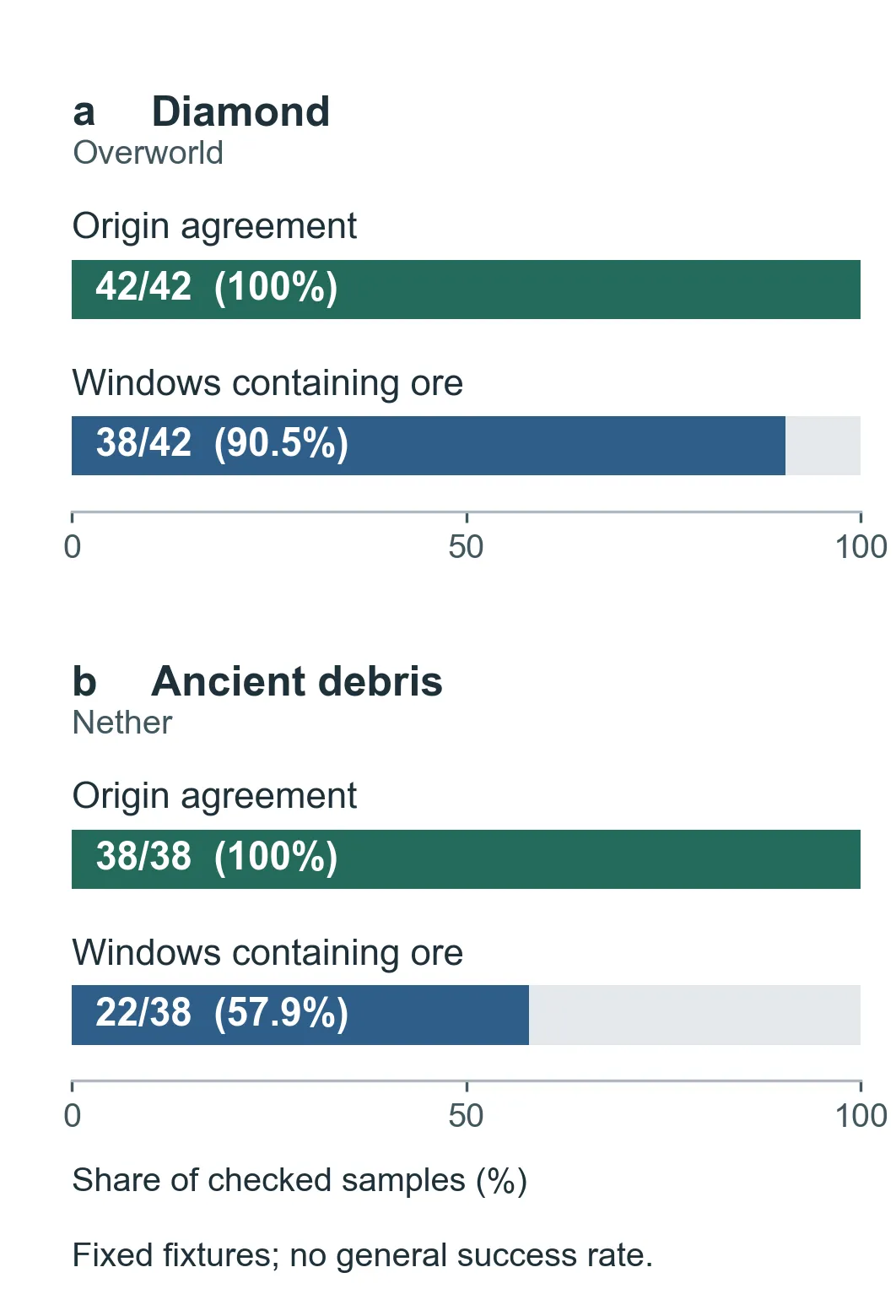
In our reviewed Java 26.3 samples, all 42 diamond placement origins and all 38 ancient-debris origins matched the game. Nearby ore appeared in 38 of the 42 diamond windows and 22 of the 38 debris windows. A matching origin therefore does not guarantee ore at the coordinate, or even within the small area we checked around it.
These comparisons were reviewed on October 2, 2026. Our Java 26.3 ore measurements give the full counts, fixed search settings and replay links. The results support the sampled origin predictions, while the finders’ outputs remain model predictions. They do not establish a general chance of finding diamonds or debris.
What a finder target means
A target is the predicted origin of an ore placement attempt: the point where that attempt begins. It is useful for choosing an area to inspect, but it does not describe a confirmed ore block or a completed deposit.
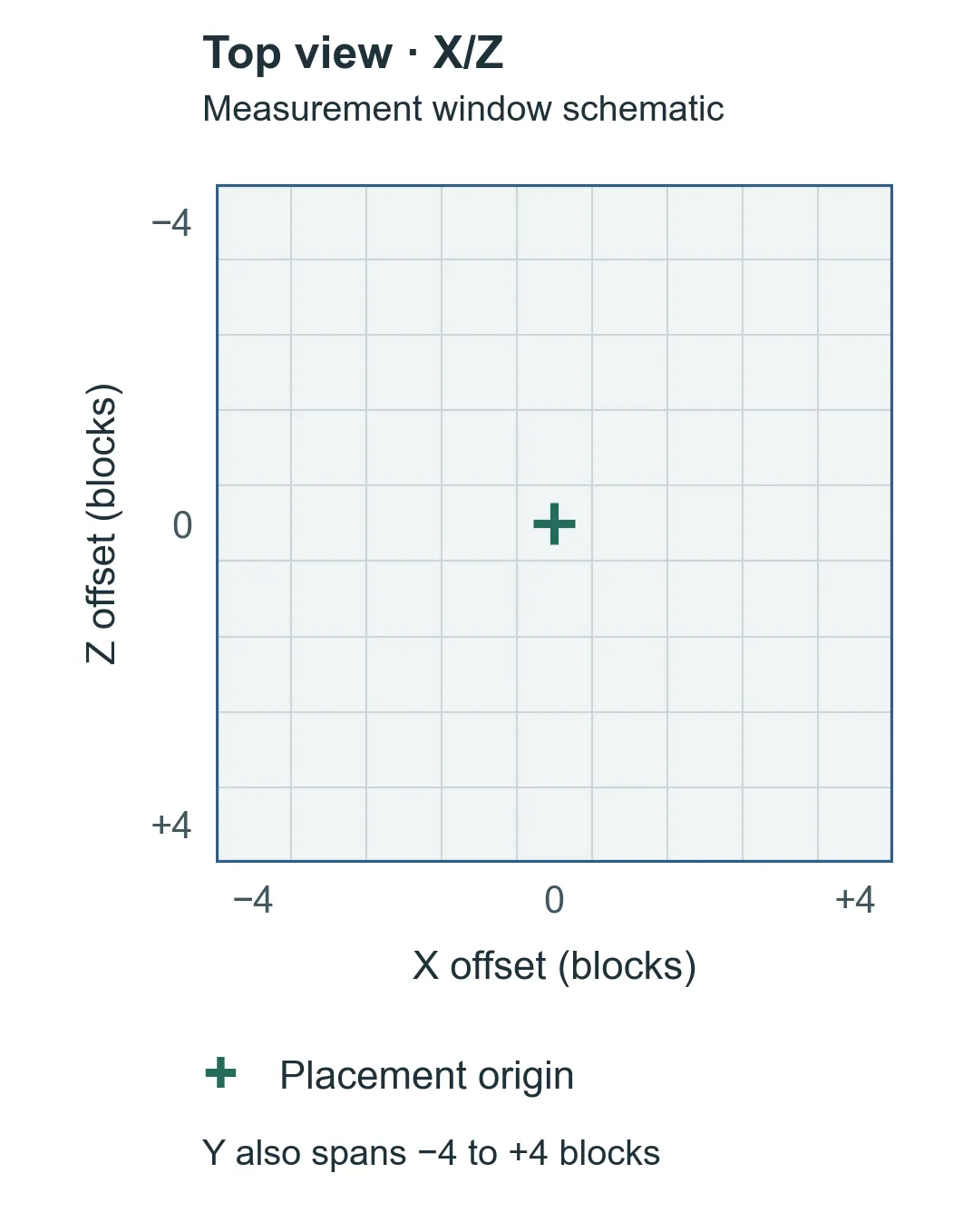
The nearby-block measurement asks a separate question: does a small window around that origin contain any of the ore? Each checked window extended four blocks along X, Y and Z, making at most a 9 × 9 × 9 area, clipped at build height where needed. That is the measurement’s boundary, not a promise that searching that far will find ore.
Four diamond windows and sixteen debris windows were empty even though their origins matched. Conversely, finding ore nearby does not prove that the origin block contains ore, or identify which attempt produced those blocks. The count tells us about the checked area, without explaining every step that led to its contents.
Current finder results
These screenshots show the current Java 26.3 finders using seed 0, centre X 0, Z 0 and chunk radius 0, which scans one chunk in the selected dimension. The result table gives each predicted origin’s X, Y and Z, its horizontal distance and its source chunk. It does not report how many ore blocks exist there.
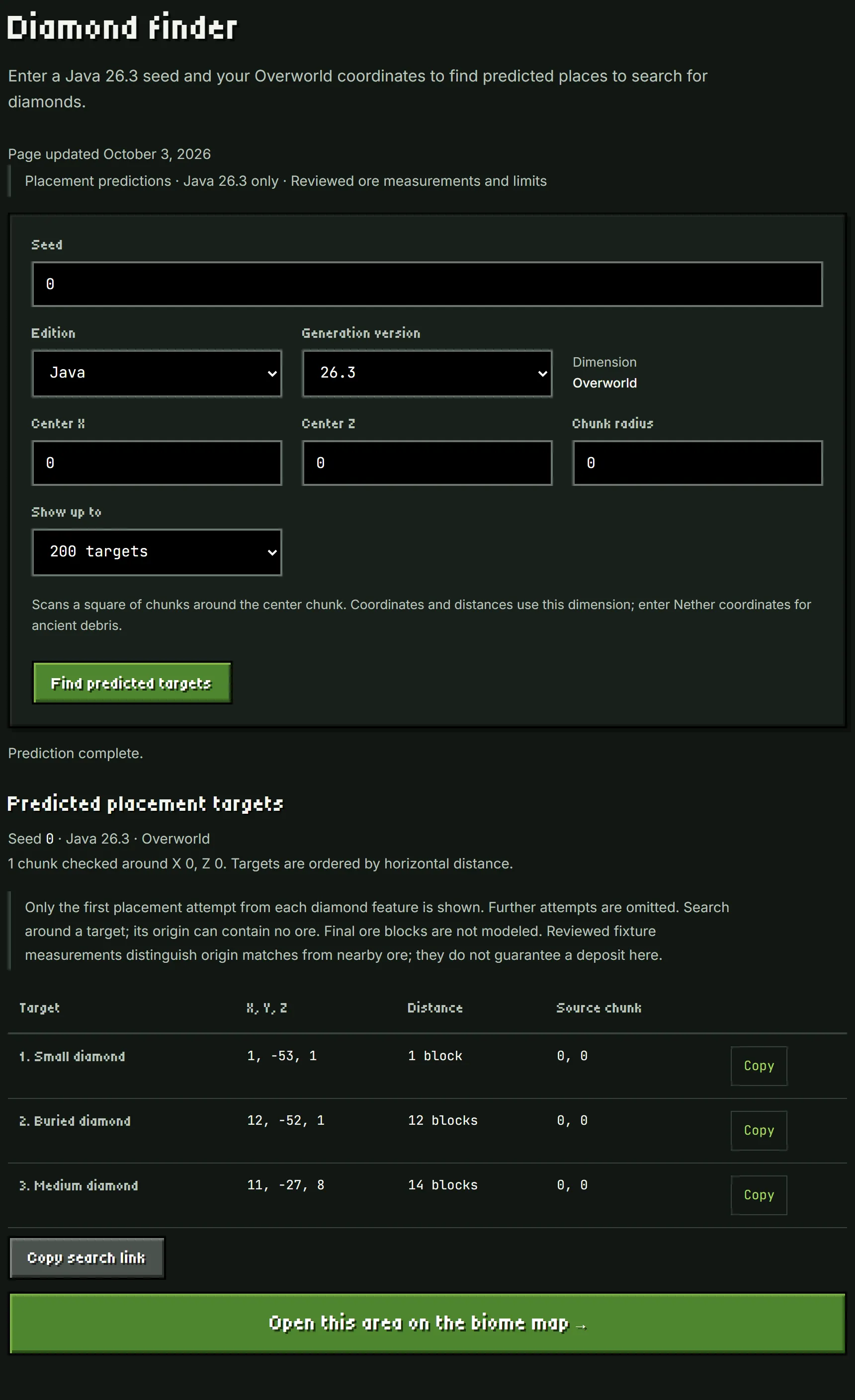
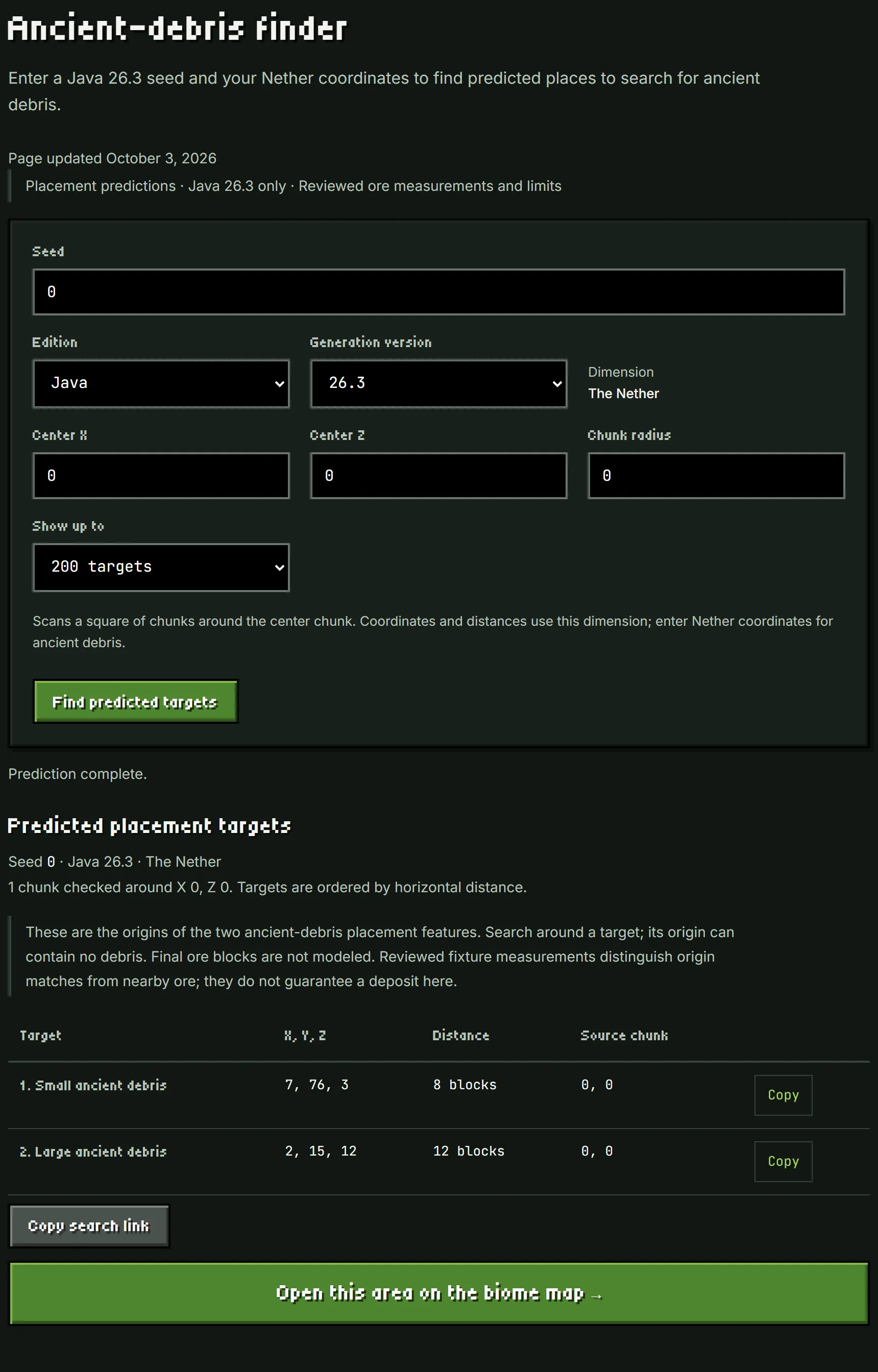
Both images capture the finder interface and its model predictions. They are separate from the reviewed in-game measurements above, and add no new game checks.
What to check before mining
If you reach a target and see nothing, check the search’s inputs before interpreting the miss:
- Use the exact seed and the right chunks. These ore tools cover standard Java 26.3 generation. Check which version generated the area you are visiting. An upgraded world can contain chunks from several versions; upgrading the game does not regenerate existing terrain. Older Java releases, Bedrock and custom generation are outside these measurements.
- Use coordinates from the target’s dimension. The diamond finder uses the Overworld. The ancient-debris finder uses the Nether. Enter Nether X and Z for debris; that tool does not convert Overworld coordinates for you.
- Read all three result coordinates. X and Z choose the search area, but each target also has a Y coordinate. Treat its X, Y and Z as a placement origin and inspect the surrounding area, without expecting that single block to be ore.
If that area is empty, an empty window alone cannot tell you whether the predicted origin is wrong. Our checked samples include origins that agree with the game and have no ore nearby. Nor does an empty window show that the whole chunk contains no ore. Keep the search settings if you want to revisit the prediction; a shared finder link reruns the model rather than checking a new game world.
Why some ore is outside the prediction
The diamond finder models only the first placement attempt from each of four diamond features in a chunk, subject to rarity and build-height filtering. Later attempts are omitted because earlier terrain-dependent placement can change their random sequence. The results are not a list of every diamond in that chunk.
The debris finder models the origins of two features in Nether chunks. Those origins also remain distinct from final ore blocks. Neither finder reconciles final terrain, replacement blocks, air exposure or later features, and neither gives an exact ore-block count. A target cannot tell you how much ore a dig will produce.
What these measurements can tell you
The main checks used three fixed seed fixtures per ore, selected as baseline, control and boundary cases. They were not a random, representative sample of Minecraft worlds. Agreement at those origins supports the checked cases; it does not establish that every seed, biome or chunk will behave the same way.
The nearby windows can also overlap. Two windows containing ore need not represent two independent deposits. Dividing positive windows by all checked windows describes this fixture set, but it cannot supply a general mining success rate or tell you how much ore exists outside those windows.
Use the reviewed measurements and limits when assessing the evidence. For your own Java 26.3 search, open the diamond finder or ancient-debris finder with the matching dimension and generation version, and read each result as a predicted place to inspect.