 seedlookout
Java 26.3 ore finder measurements
Page updated
Game comparisons reviewed · Java 26.3 standard generation
The sampled placement origins all matched the game, but some nearby search windows contained no ore. A finder target tells you where a placement attempt begins; it does not confirm a deposit at that coordinate.
For help using a target in your world, read how accurate diamond and ancient-debris finder targets are.
Origins and nearby ore
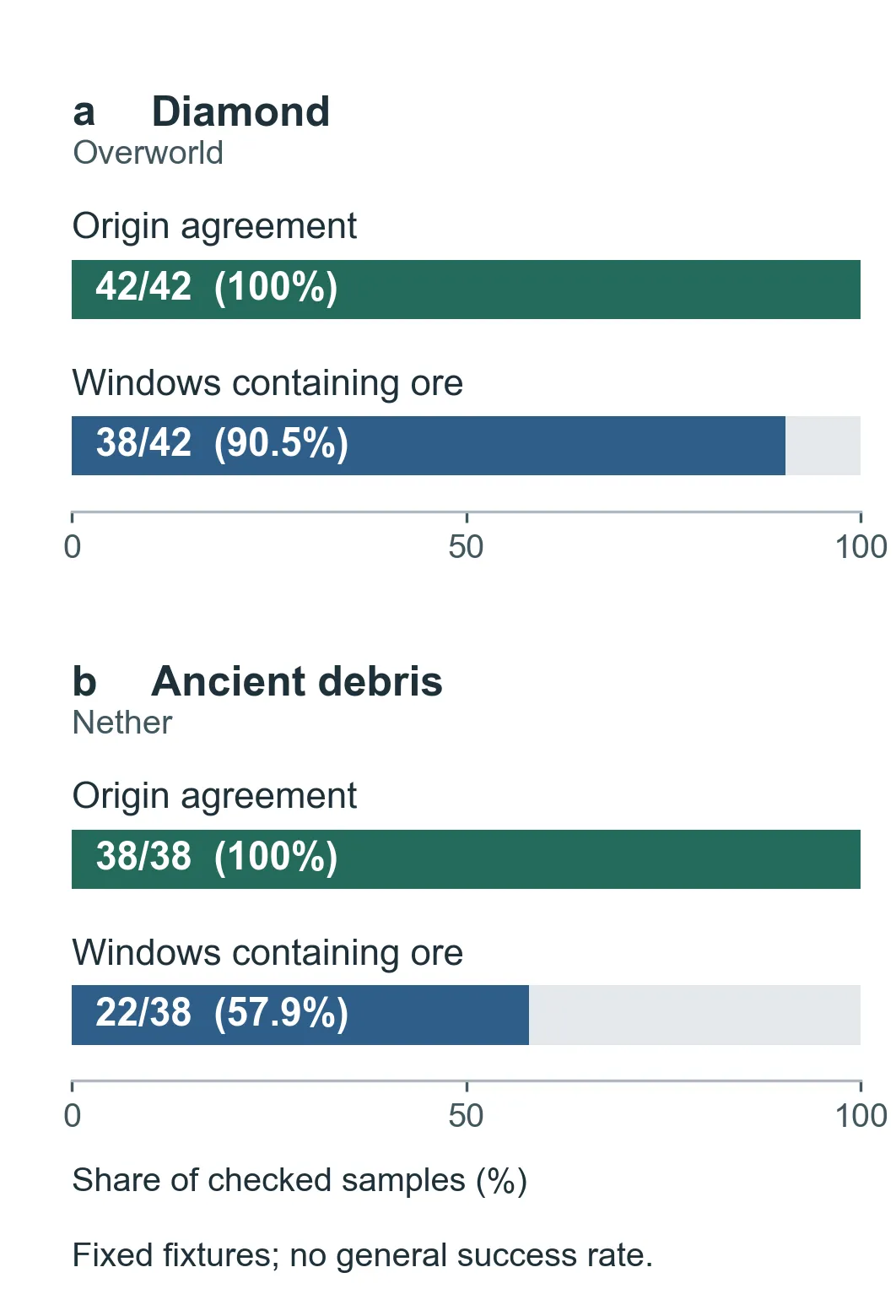
| Target | Origins matching the game | Windows containing ore | Empty windows |
|---|---|---|---|
| DiamondOverworld | 42/42 | 38/42 (90.5%) | 4 |
| Ancient debrisNether | 38/38 | 22/38 (57.9%) | 16 |
Origin matches compare each predicted X, Y and Z with the origin observed during generation in the game. Nearby block hits count windows containing at least one matching ore block in the generated chunks. These are separate observations.
Each window extends four blocks from its origin along X, Y and Z: at most 9 × 9 × 9 blocks, clipped at build height where needed. Windows can overlap, so their hits are not independent deposits. The percentages describe these checked windows only; they are not a chance of finding ore for an arbitrary seed.
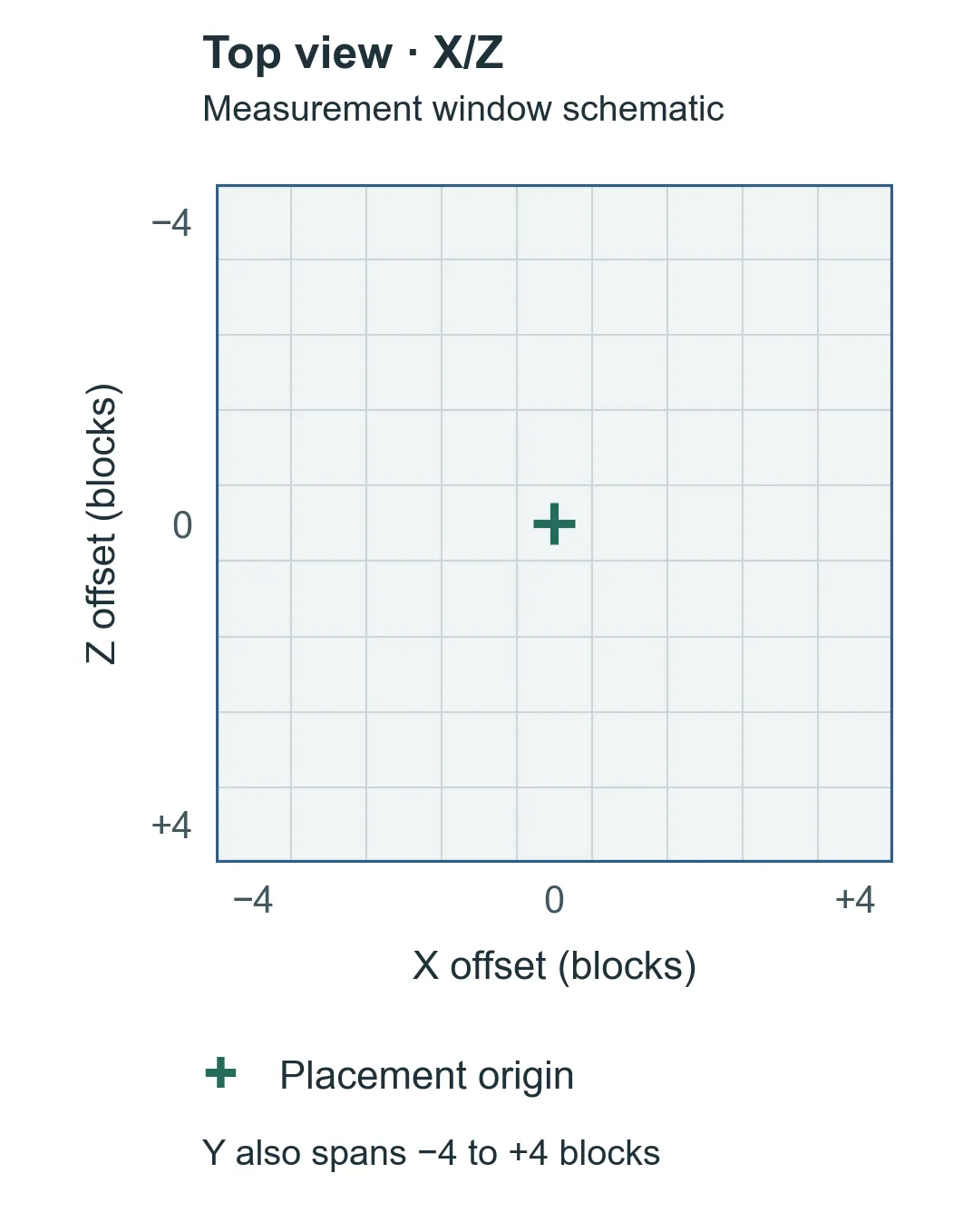
Nearby ore does not show that the origin block contains ore, or identify which attempt produced the blocks. An empty window does not rule out ore elsewhere. In the seed-0 debris fixture, both origins matched the game and both windows contained zero debris.
What the finders cover
The diamond finder shows only the first placement attempt from each of four diamond features in a chunk, subject to rarity and build-height filtering. Later diamond attempts are omitted because earlier terrain-dependent placement can change their random sequence. This does not measure all diamonds in a chunk.
The ancient-debris finder shows the origins of the two debris features in Nether chunks. Debris may scatter nearby or place no blocks. Neither finder reconciles final terrain, replacement blocks, air exposure or later features to predict exact ore blocks or ore counts.
Fixtures and reproducible searches
The queries, predictions and window bounds were fixed before generation. These measurements come from the accepted Java 26.3 recheck of the current model, with independent review of the comparisons. The results were measured in fresh official game worlds and were not carried forward from the historical initial study.
- Baseline: seed
0, center X 0, Z 0, chunk radius 0.Replay diamond prediction · Replay debris prediction - Control: seed
12345, center X -112, Z 192, chunk radius 1.Replay diamond prediction · Replay debris prediction - Boundary: seed
-9223372036854775808, center X -16, Z -17, chunk radius 1.Replay diamond prediction · Replay debris prediction
These links run the current browser predictor with the frozen search settings. They do not launch Minecraft or perform a new game check.
Separate regressions matched raw first origins in all 18 unique fixtures across nine seeds and two dimensions, including signed-seed extremes, a world-edge case, below-height diamond origins excluded from display, and four selected large-diamond rarity successes. Those selected regressions are separate from the 42 and 38 displayed targets above.
Limits of the measurements
This is a finite set of baseline, control, boundary and selected regression fixtures, not a random or representative sample. It establishes agreement within the checked bounds, not universal accuracy, full ore coverage, mining yield or performance on every biome and seed. A matching origin can still lead to an empty search window.
Use the version that generated your chunks. Updating an old world to 26.3 does not regenerate existing terrain. Bedrock, older Java releases, custom data packs and nonstandard world generation are outside these measurements. Finder outputs remain model predictions; this study does not verify or publish catalogue seed records.