seedlookout
SeedCard Finder 1.0.0 is our newly named seed-search release. Its product version is separate from the Minecraft generation version you select. We have improved our Java 26.3 seed finders by correcting structure eligibility, terrain checks and desert-temple chest positions. One repair brings back a real temple our old model wrongly left off the map. Others address mineshafts, Nether fossils, End cities, trail ruins and amethyst geode predictions.
These changes affect the generation engine behind our seed map, structure finders and browser seed finder. They address a familiar problem with Minecraft seed tools: a plausible marker can survive the model’s checks even when the game rejects the structure, or an approximate check can discard a structure that really exists.
Why other seed maps can show a missing structure
Other generators describe these limits themselves. Chunkbase’s Seed Map documentation lists wrong or missing locations for several features, including amethyst geodes near caves or mineshafts. It also explains that some fossil, ruined-portal and trail-ruin markers indicate a chunk center, potentially 10 to 20 blocks from the feature, and that some features lack a Y coordinate.
The mcseedmap.net accuracy FAQ similarly says that structures can be missing from its map or marked where they never generate. It also warns that spawn estimates can be wrong for some seeds. Those are the tools’ own disclosures; they do not tell us how often either map is wrong.
A generation model has to account for more than a likely X and Z. The original Cubiomes documentation explains the separation between placement attempts and biome checks, then describes how terrain conditions can reject some structures. A biome-compatible position is only part of the answer.
SeedLookout builds on the xpple Java Cubiomes fork. Our work adds Java 26.3 checks and corrections to that foundation. The improvements below describe our repaired model compared with our previous one; we have not measured an overall accuracy ranking against other current seed maps.
A real temple our old model missed
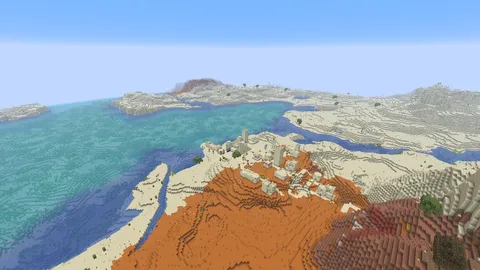
In Java 26.3, seed 635482260673531 has a desert temple at X, Y, Z: 32, 72, 0. We checked that location in the game, and it is published as the badlands shore temple and village seed.
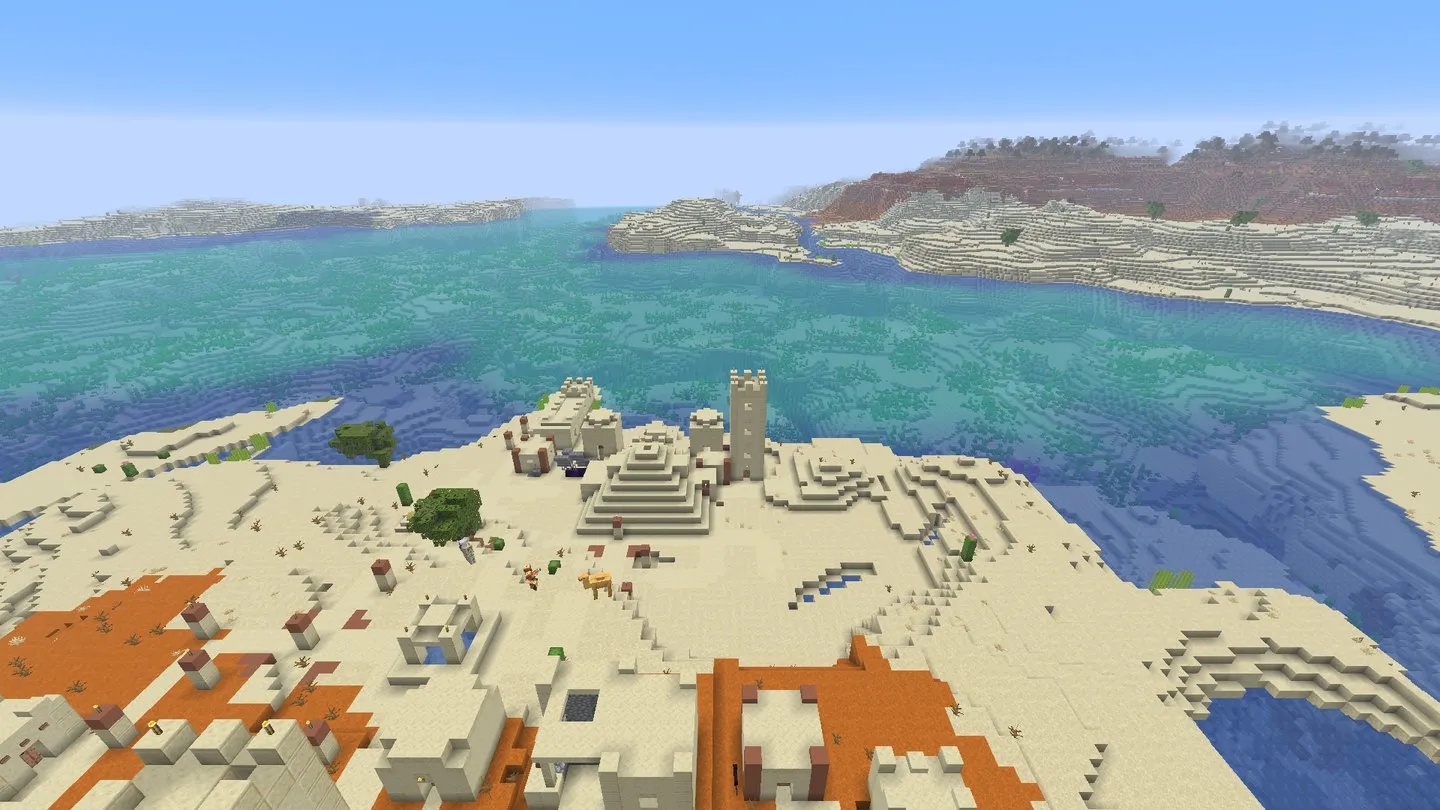
The photograph shows the temple at that checked location. Our old approximate terrain check rejected its placement. The repaired Java 26.3 map and nearest-temple search retain it.
The correction matters near the game’s sea-level threshold. Instead of using approximate terrain height as the final rejection rule, the new default Java 26.3 temple check evaluates occupied terrain columns at the structure’s four corners. It preserves the game’s eligibility threshold. In the selected reference cases, the model matched all 80 corner heights and all 20 temple eligibility decisions from Java 26.3’s generation rules.
For a player looking for temples, this changes which candidates survive the terrain check and restores this actual temple to the map. This particular correction covers the default Java 26.3 Overworld. It does not turn the terrain shading into an exact block map or establish the same result for Large Biomes.
We also corrected desert-temple loot predictions. The model now keeps the directional loot draws associated with the correct chests and transforms chest positions with the temple’s orientation. This addresses a case where an enchanted-apple prediction pointed to the wrong chest.
The enchanted apple layer still covers Java desert temple chests only. The pictured catalogue temple has checked structure coordinates; its photograph and catalogue status make no promise about an enchanted apple in its loot.
Fixing more than temple markers
Several repairs concern the conditions that decide whether a candidate can generate, or where its pieces belong. These are changes to the Java 26.3 generation model:
| Feature | What we corrected |
|---|---|
 Desert temples Desert temples |
Four-corner terrain checks, chest positions and directional loot draws. |
 Mineshafts Mineshafts |
Biome checks at generation height across the assembled structure pieces. |
 Nether fossils Nether fossils |
The biome at the randomized placement origin and the supporting terrain check. |
 Dried ghasts Dried ghasts |
The X, Y and Z position after the fossil template is rotated. |
 End cities End cities |
The terrain footprint used to judge candidate eligibility. |
 Trail ruins Trail ruins |
The biome check at the initial position used to start generating the structure. |
 Amethyst geodes Amethyst geodes |
Default-world terrain, carved caves and modeled underground fluids before retaining a candidate. |
The geode repair is especially relevant to the caveat other seed maps describe. A plausible geode origin does not account for every interaction with the surrounding world. Adding the missing terrain and material checks lets our model reject more unsuitable candidates before displaying them.
There are still limits: the geode model does not reproduce every structure, surface or earlier-feature interaction in the final world. A geode marker remains a prediction. The repair improves the modeled generation conditions without making every underground marker certain.
What the latest results establish
The October 2 reviews each covered 135 comparisons across 45 Java 26.3 feature families. The chart shows the recorded outcomes before the repairs and for the repaired model in SeedCard Finder 1.0.0.
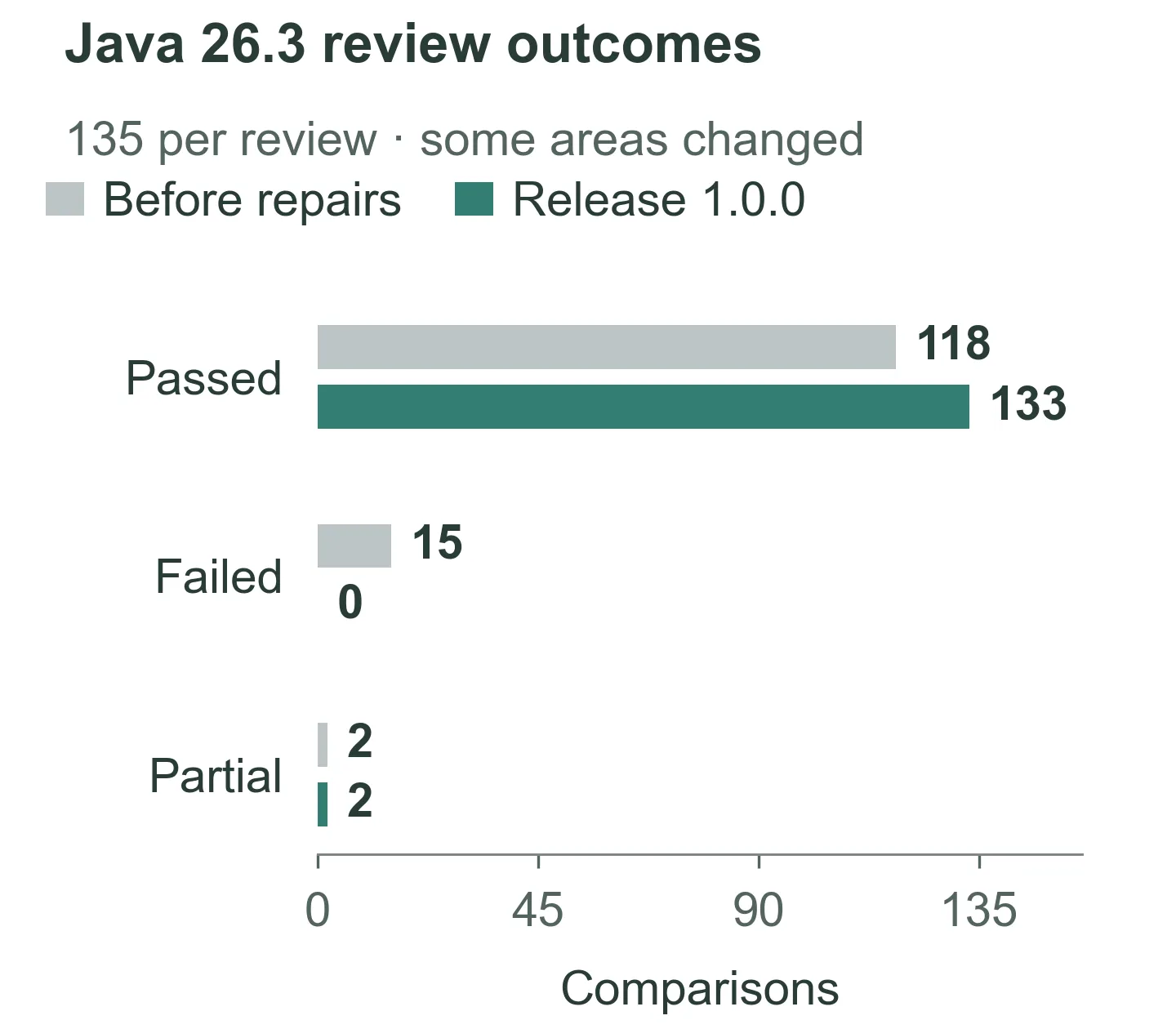
Some test areas changed between the studies, and some feature cases still lack a positive example. Those totals therefore describe the reviewed cases, not a controlled increase in accuracy across all Minecraft seeds. They also do not mean every earlier failed location was individually resolved.
Flatness and island surface estimates remain partial: both exceed the declared height-error tolerance. Approximate terrain can still mislead you when choosing a flat building area or judging an island’s surface.
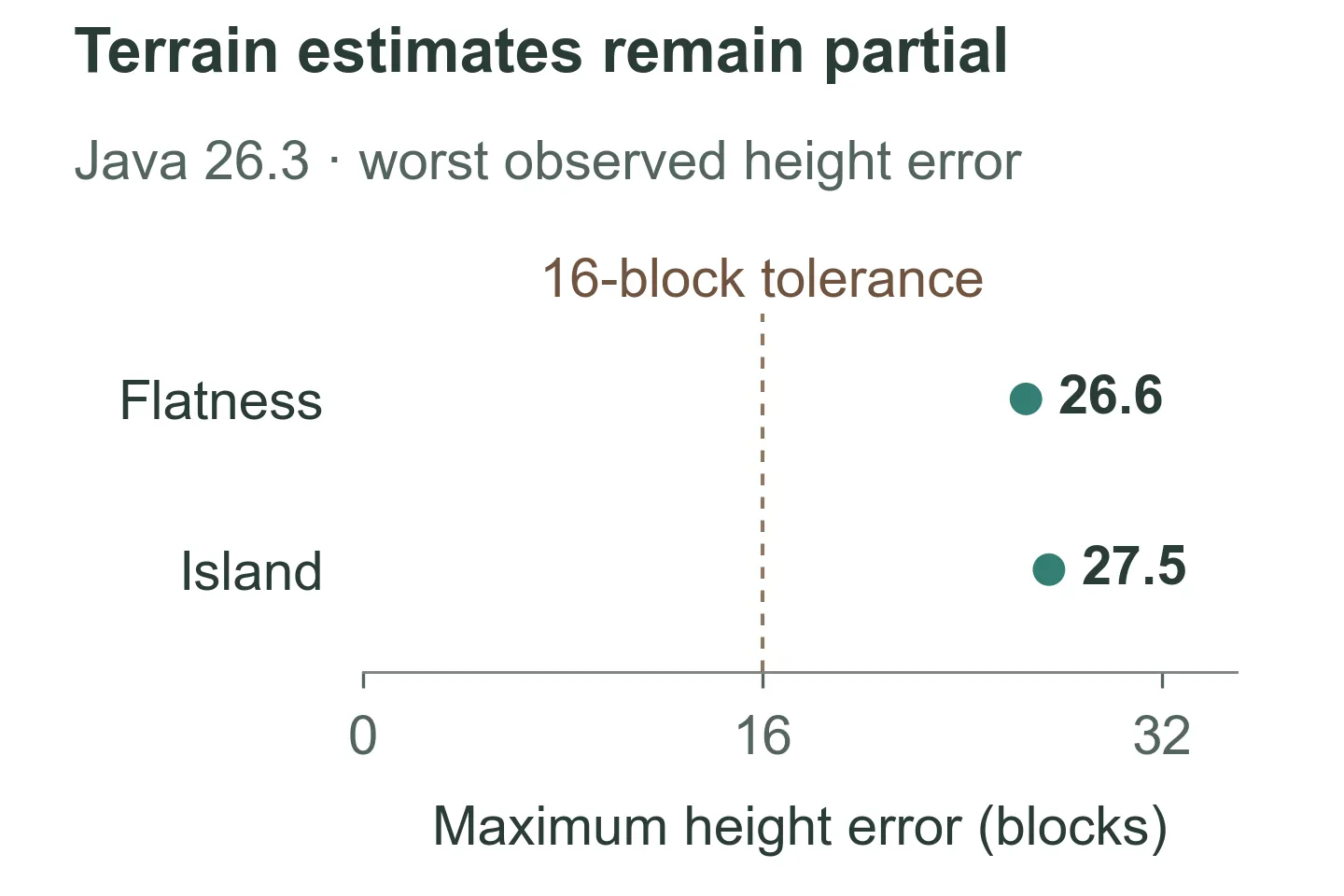
Ore tools have a separate limit. A diamond target or ancient-debris target represents a modeled placement origin. It does not guarantee a final ore block at that coordinate.
The repairs and results here concern Java 26.3. They do not establish new accuracy claims for Bedrock or older Java releases.
Using the updated finders
Choose the edition and generation version before interpreting a marker. For an upgraded world, use the version that generated the region you are exploring. Mods, data packs and custom world settings can change generation; the new exact temple terrain check described here is scoped to default Java 26.3 worlds.
Open SeedCard Finder 1.0.0 for Java 26.3 to search for a new world with the conditions you choose. The link selects Java 26.3; your saved search keeps its original settings if you resume it. Matches remain model predictions.
To see the recovered temple, open its desert temple finder result. The link uses seed 635482260673531 and searches from X, Z: 32, 0. Compare the prediction with the location and original screenshots on the published temple seed page.
For worlds with separately checked locations, browse the Java 26.3 seed pages. Each page lists what we checked in that release; the About page explains the scope.
 Village
 Ruined portal
 Trial chambers
 Badlands
 Desert
 Coast
Coast