seedlookout
SeedLookout is a catalogue of Minecraft seeds that we have loaded in the exact game version they are listed for. Every location a seed page lists was found at its coordinates in that version, and every screenshot on the page comes from the game itself. We started building it at the end of September 2026. As of today it has 116 seeds checked in game: 106 for Java 26.3 and 10 for Java 1.20.1.
We are also building tools for players to use on any seed, all running in the browser: a seed map, a seed finder and a set of world tools.
Why we started
We wanted a seed list where the coordinates hold up when you load the world, and tools that say plainly how far their output can be trusted. Before building anything, we collected 674 public seed listings from 181 pages. Of those listings, 81 did not say which game version the seed was for, and 28 did not say whether it was Java or Bedrock.
Those gaps matter because a seed does not always give the same world. When an update changes world generation, the same seed can produce different terrain. Java and Bedrock can share a seed’s terrain and biomes and still place structures differently. The About page explains how to match a seed to your game. We treat every listing we collect as unverified, and it stays in our research files, off the site, until we have checked it ourselves.
How a seed gets checked
For each seed, our verification runner starts the official Minecraft server for the listed release, on a fresh world, after checking the server file against Mojang’s published hash. It asks the game to locate each listed structure, then reads the generated structure from the saved world. A location passes when a generated piece of that structure is within 16 blocks horizontally and 32 blocks vertically of the listed coordinate. Biome claims are read from the generated chunks’ own biome data.
Then the real Minecraft client for that release joins the world and takes the screenshots, with vanilla textures. It takes six views of each surface location and four of each underground one. Every published image carries a caption with the version and coordinates. A full run takes roughly 10 to 16 minutes per seed on our development PC.
A person reviews every run: we check each verdict, confirm that each screenshot shows the feature it is supposed to show, and write a note in the review log. A seed is published only after that review, and our import step refuses any run where a listed location did not pass. The log holds 138 runs so far. In 14 of the seeds we ran, at least one listed structure was not where the listing put it: the nearest one the game generated was often hundreds of blocks away. None of those 14 seeds is on the site.
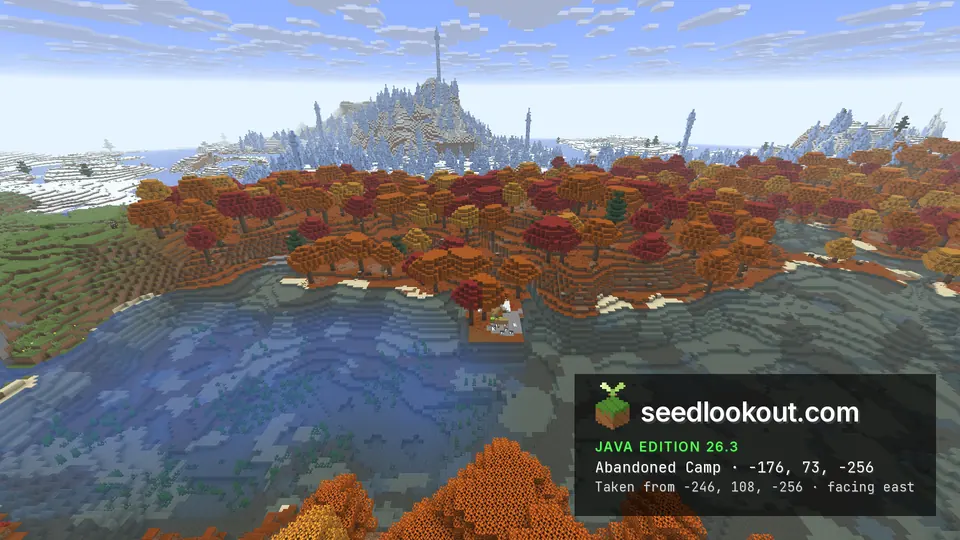
Seed 17108149081942125 in Java 26.3 lists a dappled forest abandoned camp at -176, 73, -256. The listed X and Z fall inside the camp the game generated, and this is what the client saw from the west:
What “checked in game” covers
A check covers the structures and biomes listed on the seed’s page, at their coordinates, in that one version. It does not cover loot, the spawn point or any other version. If you play a seed in a different release, test the locations yourself before you rely on them.
Each seed page also credits the source that listed it. The credit says a creator included the seed in a published collection; it makes no claim about who discovered it.
The tools
The seed map shows biomes and predicted structures for Java and Bedrock in the Overworld, Nether and End. The seed finder tests a range of seeds for the biomes and structures you choose at an exact version, and opens each match on the map. The world tools read the seed and spawn point from a world file, find slime chunks, build Java superflat presets and estimate a stronghold’s position from two Eye of Ender throws.
Everything these tools show is a model prediction. We have not checked their output in the game, and the pages say so. The finder cannot search every seed and can miss small biome patches. The map is built on open-source Cubiomes forks, with separate Java and Bedrock builds so a Java prediction is never shown as a Bedrock one. Some features are still missing (the map does not predict Java dungeons, for example), and the About page lists the gaps we know about.
What comes next
We will keep working through the queue of listed seeds and publish only the ones whose runs confirm every listed location. We will add more Java releases to the verification runner one version at a time. Bedrock seeds will stay off the catalogue until we have a tested way to check them.
You can browse the catalogue and filter it by version. The About page has the full definition of what we check.