 seedlookout
 Seeds
 Seed map
 Seed finder
 Structures
 Tools
 Articles
 About
OVERWORLD · TEMPLES
Desert Pyramid
Page updated
Players raid desert pyramids for the Dune armor trims and valuables in four buried chests, and brush a separate archaeology room for pottery sherds. A pressure plate between the chests sets off nine TNT blocks below them.
This guide follows vanilla Java 26.3. Historical changes retain their own edition and version. Bedrock generation and loot can differ. Screenshots and verified seeds below retain their own game versions.
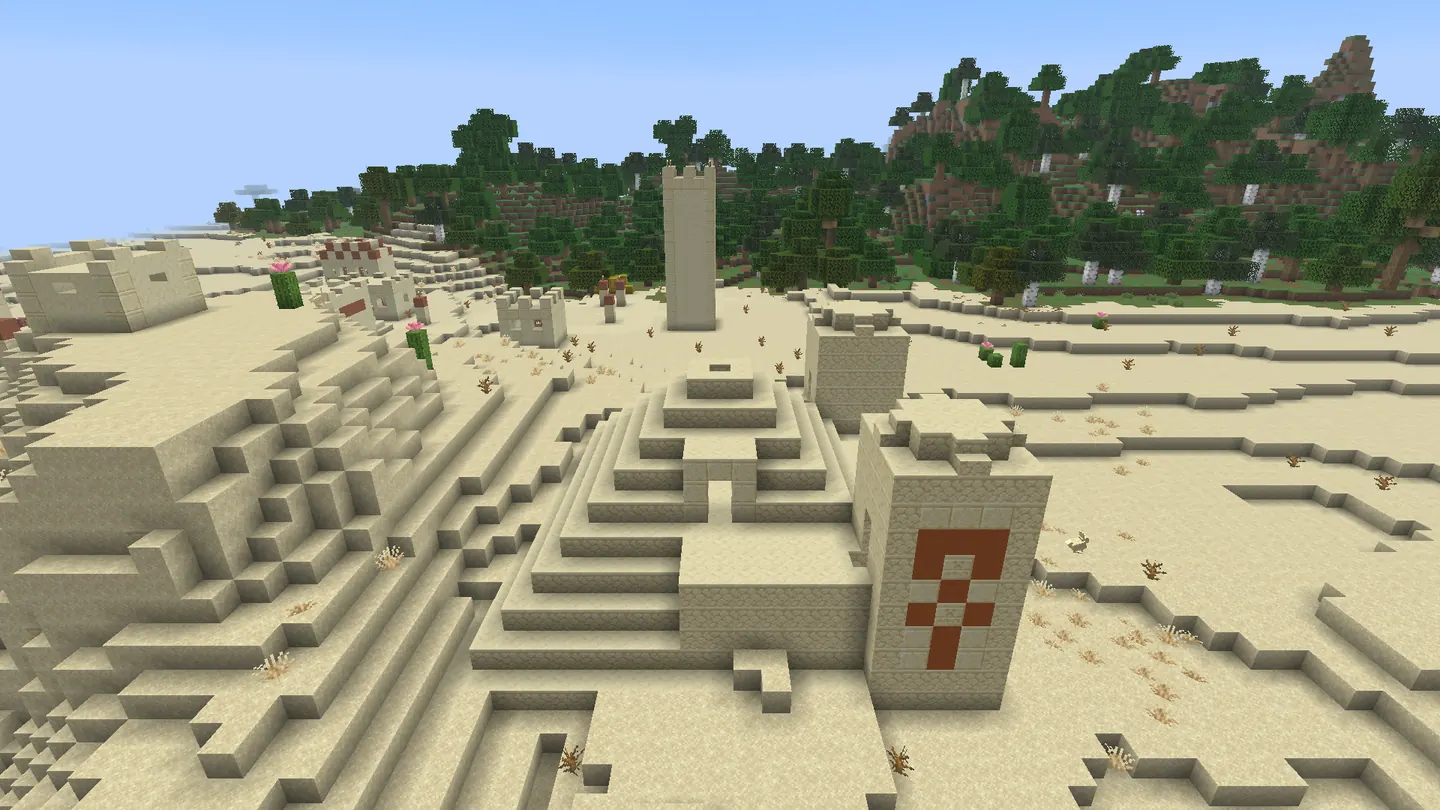
28462718234064871 · Java 26.3 · overworldReference capture · Naturally generated structure, photographed in Minecraft Java 26.3.Game data and source research
Where it generates in Java 26.3
Desert is the only eligible starting biome in Java 26.3. A desert biome alone does not guarantee a pyramid. [2][5]
Candidate positions and rarity
Java 26.3 selects one potential starting chunk per 32×32-chunk region (512 blocks on each side). Candidate selection happens before successful structure generation; this is not a measured density or an average travel distance. [3][4]
The structure constructor supplies a 21×21 horizontal size to the single-piece generation path. That path checks the lowest sampled terrain height before accepting the start; the constructor dimensions are generation inputs, not a survey of every buried or supporting block. A sampled minimum below sea level rejects the start. [1][3][4][5]
What the starting position means
Pyramids use one candidate per 32×32-chunk region before biome and generation checks. The 512-block region width is not a promised distance to the next temple. [1][4][5]
The treasure shaft and the archaeology room
The main sandstone pyramid hides a treasure chamber beneath the colored floor. Four chest positions surround its central trap area. A separate partly collapsed room provides the archaeology search area; finding the familiar shaft does not mean the whole pyramid has been explored. [6]
| Part | What to look for |
|---|---|
| Main floor | The colored center marks the shaft above the treasure chamber. [6] |
| Treasure chamber | Four chest placements around a central stone pressure plate and a 3 × 3 TNT layer below. [6] |
| Collapsed room | Sand and suspicious sand form a separate excavation target. [6] |
Disarm the trap before searching
The nine TNT blocks are placed directly below the central trigger area. Descend along a side and inspect the floor before stepping into the center. Exploding the trap can destroy both the explorer and nearby rewards. [6]
The archaeology pass selects suspicious-sand positions separately from the chest placements and adds one collapsed-roof position. Search carefully rather than treating every sand block as disposable. There is no pyramid-specific mob spawner in this construction path; darkness and surrounding terrain can still leave hostile mobs inside. [6]
Loot and rewards in Java 26.3
The buried treasure-room chest table and the archaeology table are separate systems. Each assigned chest makes 2-4 main selections from weight 247, four material selections, and a separate Dune trim draw. These chances are per chest-table invocation, not per pyramid. [7]
Dune trim weighs 1 against empty weight 6; selection produces two templates together. Finding two is one successful draw, not two independent trim rolls. [7]
The pyramid archaeology table draws one of eight equally weighted outcomes: Archer, Miner, Prize and Skull pottery sherds, diamond, TNT, gunpowder or emerald. Each probability applies to one successfully brushed block assigned this table; it is not the fraction of all sand in the building. [7]
Compared directly with Java 1.20.1, the Java 26.3 tables differ. The inspected desert pyramid table gains Copper horse armor, Leather and no longer lists Saddle; its first pool changes from total weight 232 to 247. Use the current weights rather than carrying older chest percentages forward. [7][9]
| Item | Where the rule applies | What the data establishes |
|---|---|---|
 Dune armor trim smithing template | One pyramid-table chest | 14.3% chance; two templates on a successful trim draw. [7][8] |
 Enchanted golden apple | One pyramid-table chest | 2.4% chance of at least one apple selection. [7][8] |
 Diamond | One pyramid-table chest | 5.9% chance of at least one selection; 1-3 diamonds per selection. [7][8] |
 Archer pottery sherd | One successful pyramid-table brush | 12.5% chance; one sherd. The other three pyramid sherds have the same weight. [7][8] |
Version history and release dates
These milestones retain their edition and exact build labels. Snapshot, beta and preview dates belong to those development builds; full releases and staggered Pocket platform releases are dated separately. Historical introduction claims come from the cited Wiki history. [10]
| Version | Released | What changed |
|---|---|---|
| Java 1.3.1 | August 1, 2012 | Introduced desert pyramids in snapshot 12w21a. [10][12] |
| Pocket 0.13.0 | November 19, 2015 | Added desert pyramids to Pocket Edition, the predecessor of Bedrock Edition. [10][13] |
| Java 1.18 | November 30, 2021 | Reworked placement around the terrain surface, allowing partial burial and preventing placement over water. [10][14] |
| Java 1.20 | June 7, 2023 | The archaeology loot table was revised. The new room's top layer now includes a suspicious sand block that players can see. [10][15] |
| Java 1.21.6 | June 17, 2025 | Replaced saddle chest loot with stacks of one to five leather. [10][16] |
| Bedrock 1.21.90 | June 17, 2025 | Replaced saddle chest loot with stacks of one to five leather. [10][17] |
| Java 1.21.9 | September 30, 2025 | Copper horse armor joined the chest loot. [10][18] |
| Java 26.3 | September 15, 2026 | Abandoned camps became a source of Desert Pyramid Maps. [10][19] |
| Bedrock 26.50 | September 15, 2026 | Abandoned camps became a source of explorer maps to desert pyramids. [10][20] |
Checked in game by SeedLookout
Screenshots
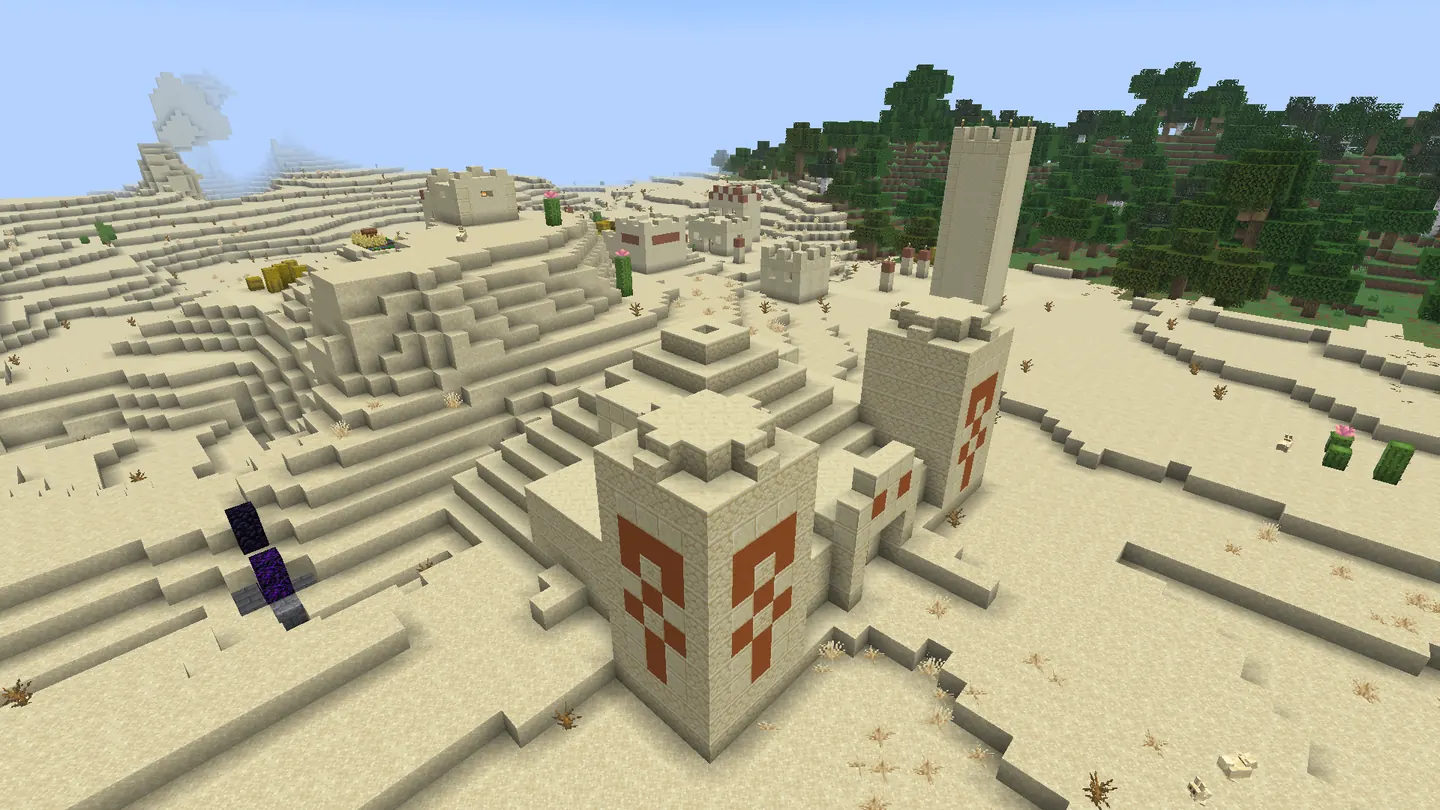
28462718234064871 · Java 26.3 · overworldReference capture · Naturally generated structure, photographed in Minecraft Java 26.3.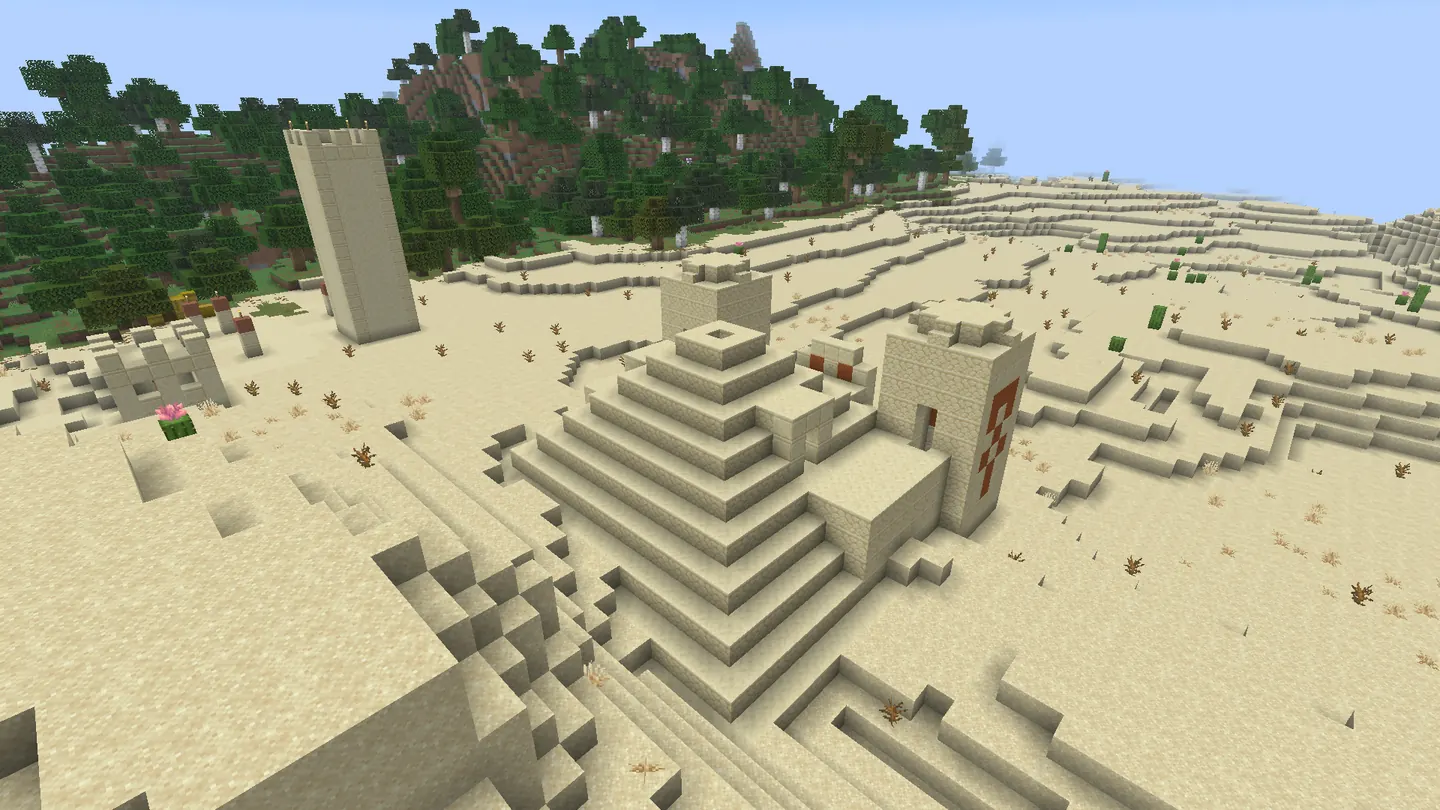
28462718234064871 · Java 26.3 · overworldReference capture · Naturally generated structure, photographed in Minecraft Java 26.3.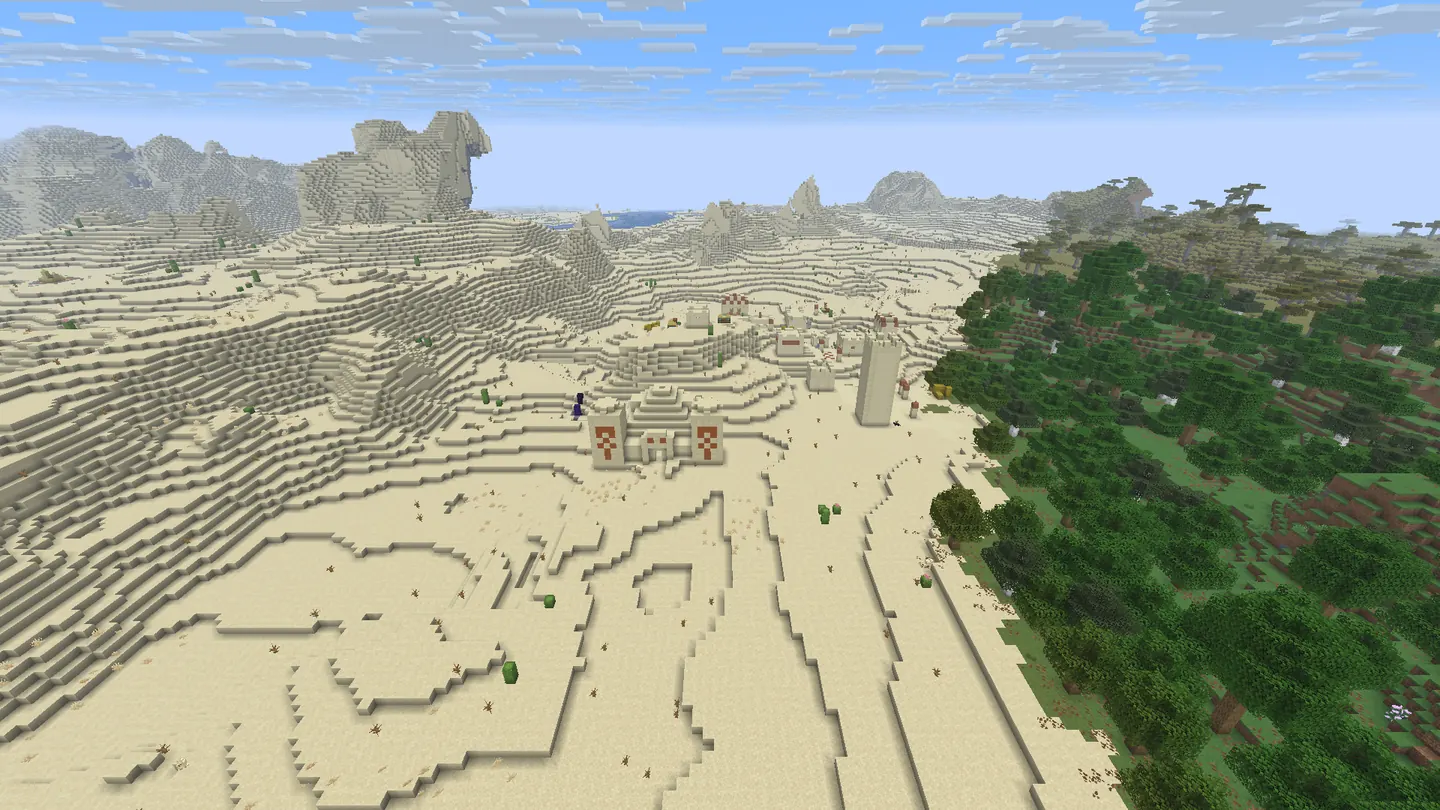
28462718234064871 · Java 26.3The desert pyramid and village, looking south.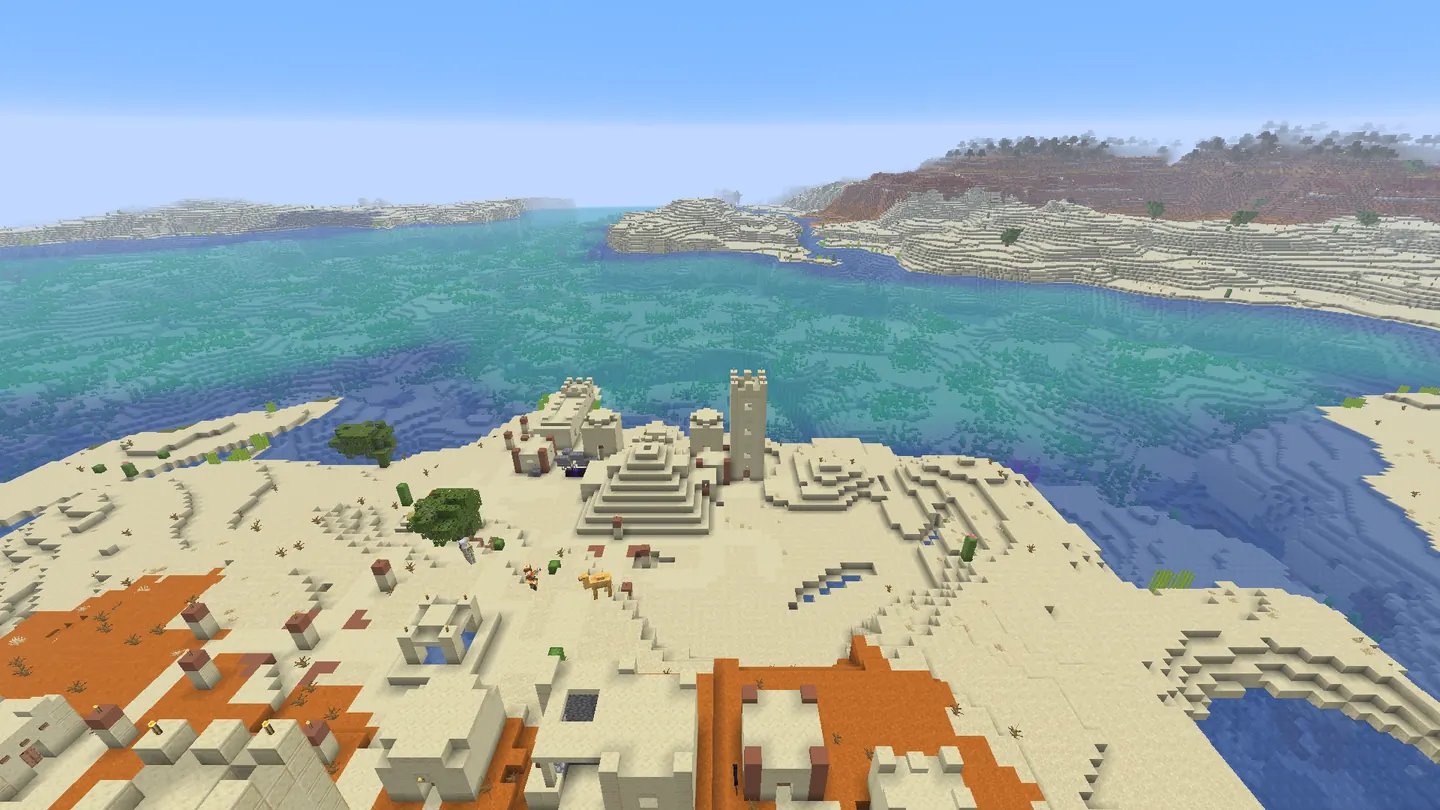
635482260673531 · Java 26.3The temple at 32, 72, 0 beside the badlands shore.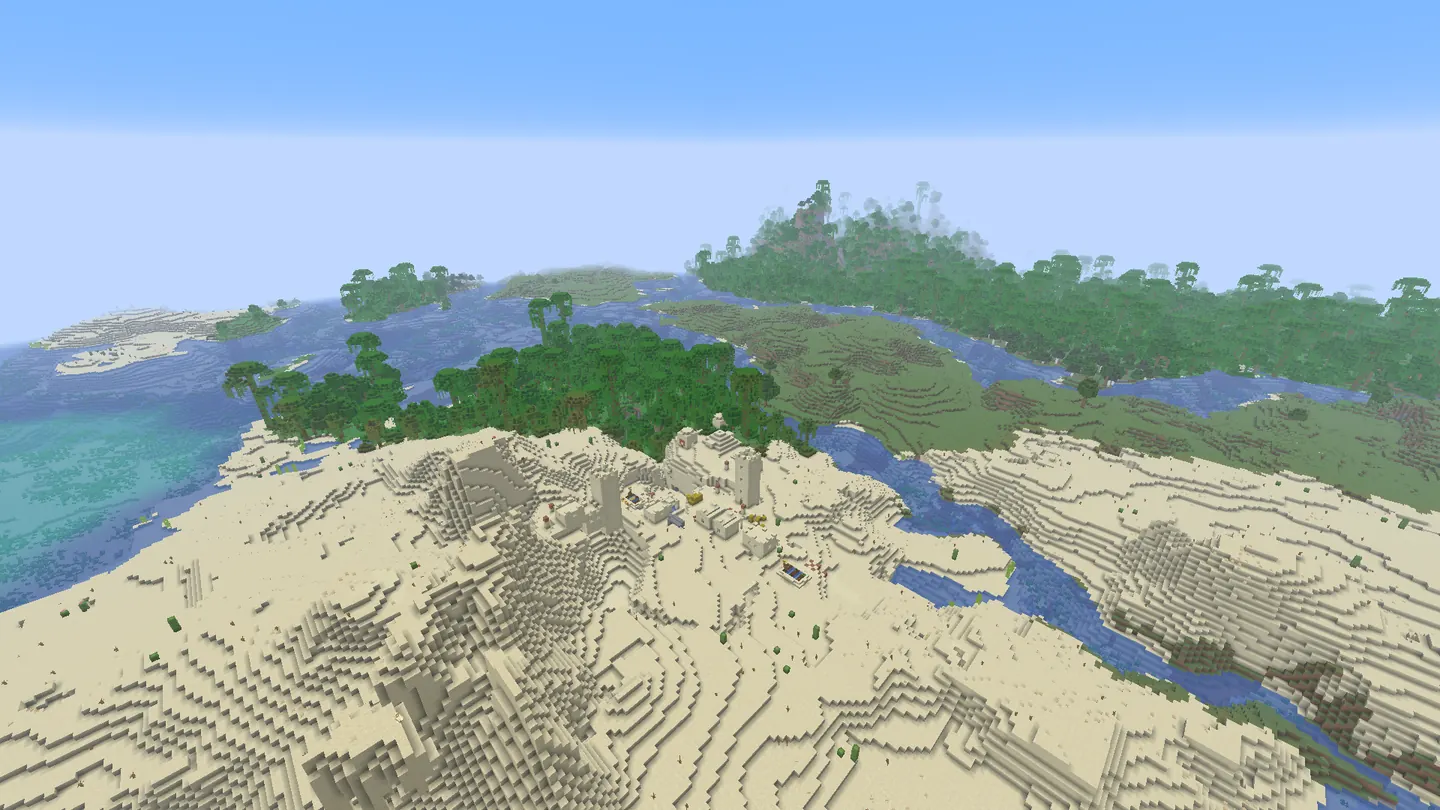
3035361386383305 · Java 26.3The temple area and dune valley; the temple is not clearly exposed.Our screenshots of naturally generated structures in Minecraft. Each caption gives the seed, coordinates and version. Select one to open it at full size.
Seeds with desert temples
The coordinates below identify our in-game check locations in each seed's Java version. Other versions and Bedrock may generate a different world.
| Seed | Version | Variant | X, Y, Z |
|---|---|---|---|
Desert pyramid at the edge of a desert village, with a ruined portal beside it28462718234064871 | Java 26.3 | Desert temple | 64, 76, 80 |
Desert temple and sandstone village at a badlands shore635482260673531 | Java 26.3 | Desert temple | 32, 72, 0 |
Desert village between high dunes and a jungle edge3035361386383305 | Java 26.3 | Desert temple | 48, 76, 16 |
Desert temple among village houses beside a sandstone cliff408849847 | Java 1.20.1 | Desert temple | 0, 80, 0 |
Sources
References identify the edition, version and evidence behind the guide. Game code and data describe generation rules; the seed table records locations checked in game. Research reviewed 2026-10-02.
- Mojang Java 26.3: structure configuration ↗
Inner archive META-INF/versions/26.3/server-26.3.jar: data/minecraft/worldgen/structure/desert_pyramid.json
- Mojang Java 26.3: resolved starting-biome tags ↗
Inner archive META-INF/versions/26.3/server-26.3.jar: data/minecraft/tags/worldgen/biome/has_structure/desert_pyramid.json
- Mojang Java 26.3: candidate placement settings ↗
Inner archive META-INF/versions/26.3/server-26.3.jar: data/minecraft/worldgen/structure_set/desert_pyramids.json
- Mojang Java 26.3: candidate filtering and weighted retries ↗
Inner archive META-INF/versions/26.3/server-26.3.jar: net/minecraft/world/level/chunk/ChunkGenerator.class; net/minecraft/world/level/levelgen/structure/placement/AbstractSpreadingStructurePlacement$ExclusionZone.class; net/minecraft/world/level/levelgen/structure/placement/AbstractSpreadingStructurePlacement$FrequencyReducer.class; net/minecraft/world/level/levelgen/structure/placement/AbstractSpreadingStructurePlacement$FrequencyReductionMethod.class; net/minecraft/world/level/levelgen/structure/placement/AbstractSpreadingStructurePlacement.class; net/minecraft/world/level/levelgen/structure/placement/RandomSpreadStructurePlacement.class. Methods: RandomSpreadStructurePlacement.getPotentialStructureChunk; AbstractSpreadingStructurePlacement.isStructureChunk; ChunkGenerator.createStructures / tryGenerateStructure
- Mojang Java 26.3: generation entry points ↗
Inner archive META-INF/versions/26.3/server-26.3.jar: net/minecraft/world/level/levelgen/structure/SinglePieceStructure$PieceConstructor.class; net/minecraft/world/level/levelgen/structure/SinglePieceStructure.class; net/minecraft/world/level/levelgen/structure/Structure$GenerationContext.class; net/minecraft/world/level/levelgen/structure/Structure$GenerationStub.class; net/minecraft/world/level/levelgen/structure/Structure$StructureSettings$Builder.class; net/minecraft/world/level/levelgen/structure/Structure$StructureSettings.class; net/minecraft/world/level/levelgen/structure/Structure.class; net/minecraft/world/level/levelgen/structure/structures/DesertPyramidStructure.class. Methods: DesertPyramidStructure constructor; Structure.findValidGenerationPoint; Structure.GenerationContext.isValidBiome; SinglePieceStructure.findGenerationPoint
- Mojang Java 26.3: desert pyramid layout and encounter implementation ↗
net.minecraft.world.level.levelgen.structure.structures.DesertPyramidPiece; net.minecraft.world.level.levelgen.structure.structures.DesertPyramidStructure; DesertPyramidPiece.postProcess, addCellar, addCellarStairs and potential suspicious-sand position collection; DesertPyramidStructure.afterPlace / placeSuspiciousSand.
- Mojang Java 26.3: desert pyramid loot data ↗
Inner META-INF/versions/26.3/server-26.3.jar: data/minecraft/loot_table/chests/desert_pyramid.json; data/minecraft/loot_table/archaeology/desert_pyramid.json
Evidence details
Table identity and conditional item rules are distinct from any particular generated container.
- Java 26.3 desert pyramid: calculated selection odds ↗
Relevant /pools indices in the data reference; LootPool.addRandomItem/addRandomItems; UniformContainerBase.uniformFields; UniformGenerator.getIntUnsafe.
Evidence details
For direct unconditional weighted pools, chance of at least one selection is 1 minus the average of (1−weight/totalWeight)^n over inclusive uniform integer rolls. Values are theoretical table-invocation probabilities, not seed frequencies. Exact inputs: [{"itemId":"minecraft:dune_armor_trim_smithing_template","table":"data/minecraft/loot_table/chests/desert_pyramid.json","pool":2,"fraction":"1/7","chance":0.14285714285714285,"weight":1,"total":7,"rolls":[1]},{"itemId":"minecraft:enchanted_golden_apple","table":"data/minecraft/loot_table/chests/desert_pyramid.json","pool":0,"fraction":"268815518/11166294243","chance":0.02407383435811902,"weight":2,"total":247,"rolls":[2,3,4]},{"itemId":"minecraft:diamond","table":"data/minecraft/loot_table/chests/desert_pyramid.json","pool":0,"fraction":"663016535/11166294243","chance":0.05937659536561435,"weight":5,"total":247,"rolls":[2,3,4]},{"itemId":"minecraft:archer_pottery_sherd","table":"data/minecraft/loot_table/archaeology/desert_pyramid.json","pool":0,"fraction":"1/8","chance":0.125,"weight":1,"total":8,"rolls":[1]}]
- Mojang Java 1.20.1: inspected historical desert pyramid loot ↗
data/minecraft/loot_tables/chests/desert_pyramid.json
Evidence details
Limited comparison of the listed data files; no claim that all intermediate releases share either table.
- Minecraft Wiki: Desert Pyramid — pinned history ↗
History section, retaining edition, release grouping, development-version and experimental-toggle qualifiers.
Evidence details
Pinned article revision 3790245 from 2026-09-23T11:26:09Z. Historical claims only; not an audited game build or release-date source.
- Minecraft Wiki: Desert Pyramid description ↗
Opening description and History
Evidence details
Pinned article revision 3790245; retrieved October 1, 2026. Article history supports historical introductions; current generation and loot are audited separately from game data.
- Java 1.3.1: release date ↗
Version infobox release date
Evidence details
Public release calendar date from pinned version article. Legacy metadata date 2012-07-31 disagrees; its timestamp and URL remain preserved separately.
- Pocket 0.13.0: release date ↗
Version infobox release date
Evidence details
Historical date from the pinned Minecraft Wiki version article; introduction is separately attributed to each structure article history.
- Java 1.18: release date ↗
/id; /releaseTime
Evidence details
Date belongs to the exact 1.18 build. Snapshot and prerelease dates are separate from the later full release; metadata does not prove the feature introduction.
- Java 1.20: release date ↗
Opening announcement: Trails & Tales Update will be coming to a device near you on June 7
Evidence details
Public release June 7, 2023. Mojang metadata retains releaseTime 2023-06-02T08:36:17+00:00; this earlier build timestamp must not be displayed as the public launch date.
- Java 1.21.6: release date ↗
/id; /releaseTime
Evidence details
Date belongs to the exact 1.21.6 build. Snapshot and prerelease dates are separate from the later full release; metadata does not prove the feature introduction.
- Bedrock 1.21.90: release date ↗
Version infobox release date
Evidence details
Pinned community version article date; snapshots, betas and previews have their own release dates, separately from the full version.
- Java 1.21.9: release date ↗
/id; /releaseTime
Evidence details
Date belongs to the exact 1.21.9 build. Snapshot and prerelease dates are separate from the later full release; metadata does not prove the feature introduction.
- Java 26.3: release date ↗
Published 9/15/26; Minecraft Java 26.3 Released
Evidence details
Release metadata establishes its date, not feature introduction. Original Wiki history must support introduction separately.
- Bedrock 26.50: release date ↗
Posted: 15 September 2026; opening paragraph says Wilderness Bound is out now
Evidence details
Release date from the official announcement; introduction is separately attributed to the structure article history.
Item art uses vanilla Java 26.3 assets from the official client release. Icons retain their game version alongside the guide.
SeedLookout writes these guides itself, from the game’s own data files, our analysis of its code and our in-game checks. The references above are the sources we checked facts against, each with a link. Calculations and code analysis are SeedLookout research. Screenshot captions identify each capture. The seed table contains our published verified seeds; checking a location does not establish particular room contents or chest loot.